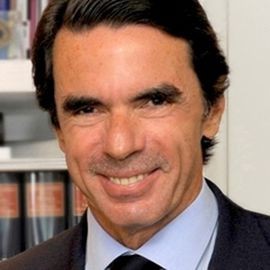
Following the Partido Popular's electoral victory in 1996, he was elected President of Spain. With the party's subsequent election victory in 2000, this time with an absolute majority, he was re-elected president of the nation for a second term. His presidency lasted until the 2004 elections when he deliberately decided not to compete for re-election.
During his two years as President of the Government, he oversaw a significant economic and social reform effort. Almost 5 million jobs have been generated in Spain as a result of different liberalization processes and the adoption of competition-promoting policies, as well as budgetary controls, rationalized public expenditure, and tax reductions.
Each year, the Spanish GDP increased by more than 2%, averaging 3.4 percent, for a total gain of 64 percent over eight years. During this time, Spain's average income grew from 78 percent to 87 percent of the European Union's average income. The public deficit was reduced from an alarming 6% of GDP to a budget that was balanced.
During his two years in government, he implemented the first two income tax cuts in democratic Spain's history. The fight against terrorism is one of José Mara Aznar's main issues. He favors a strong stance devoid of any political concessions, as well as tight international collaboration among democratic countries.
He is a staunch advocate of the Atlantic Relationship as well as the European Union's commitment to freedom and change. He is Honorary Chairman of the Partido Popular, a political party he led from 1990 to 2004.
He was Chairman of the Centrist Democrat Worldwide (CDI) and Vice-Chairman of the International Democrat Union (IDU) until 2006, the two international organizations that bring together center-right parties, as well as Liberals, Christian Democrats, and Conservatives throughout the world. José Mara Aznar entered politics in 1979 as a member of the Alianza Popular political party.
He was elected as a Member of Parliament for Vila in 1982. Between 1987 and 1989, he served as the Regional Chairman of Alianza Popular in Castile-Leon and as the Head of the Regional Government of Castile-Leon. Following the re-founding of the Partido Popular in 1989, he was picked as the party's presidential candidate in the 1989 general elections.
He was elected Chairman of the Party the following year. In the elections of 1993, 1996, and 2000, he led the Partido Popular. He was a Member of Parliament representing Madrid for these four periods. He was the Leader of the Opposition from 1989 until 1996. José Mara Aznar earned his law degree from the Universidad Complutense de Madrid.
In 1975, he earned his certification as a State Finance Inspector. From 2004 until 2011, he was a Distinguished Scholar at Georgetown University. Memorias I (2012), Espaa puede salir de la crisis (2009) (Spain Can Get Out of the Crisis), Cartas an un joven espaol (2007) (Letters to a Young Spaniard), and Retratos y perfiles are some of his works.
Bush vs. Fraga (2005) (Portraits and Profiles: From Fraga to Bush), Eight Years in Government (2004), La Espaa en que yo creo (1995), Espaa: la Segunda transición (1994) (Spain: The Second Transition), and Libertad y Solidaridad (1991) are some of the books he has written (Freedom and Solidarity).
Honorary doctorates have been bestowed upon José Mara Aznar by Sophia University in Tokyo (1997), Florida International University (1998), Bar-Ilan University in Israel (2005), Universidad Andrés Bello in Chile (2006), Universidad Francisco Marroqun in Guatemala (2006), Università Cattolica Sacro Cuore in Milán (2007), Universidad Cardenal Herrera CEU in Valencia (2009), Universidad San Ignacio de Loyola in Mexico (2009).