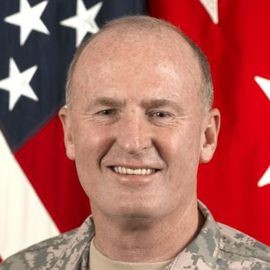
Lynch gradually rose through the ranks, eventually commanding at all levels, from the company (about 100 troops) to corps (approximately 65,000 soldiers) to the top of all US Army facilities.
He was in charge of all the sites in the US Army, with a $12 billion yearly budget and a staff of 120,000 people, and he matched the professional acumen of established corporate leaders.
He dramatically reduced divorce and suicide rates at Fort Hood, Texas, by prohibiting weekend work and requiring soldier family time, combining his immaculate work ethic with an open heart. He eloquently shows his concepts, form the basis of corporate leadership to the necessity for resiliency and involvement, by drawing on his personal experience in and out of battle.
Lieutenant General Rick Lynch is one of just 50 three-star generals in the United States. Lynch was born and reared in Hamilton, Ohio, and graduated from West Point in the top 5% of his class.
In the 17th Engineer Battalion, 2nd Armored Division, he was commissioned as a regular army engineer officer in charge of both a combat engineer company and a mobile assault bridge company. In 1985, he graduated from the Massachusetts Institute of Technology with a master's degree in mechanical engineering with a focus on robotics.
He headed the army's first-ever Digital Brigade as a colonel, emphasizing the use of new technology in combat—a skill that would come in handy on the battlefields of Iraq and Afghanistan.
He was responsible for planning and implementing operations across NATO's southern area, including all Balkans operations and Operation Active Endeavor, as deputy chief of staff for operations and commander of the Allied Joint Force Command from 2003 to 2005.
He headed a multi-national force in Iraq from 2005 to 2006 as deputy chief of staff for strategic impacts, responsible for integrating the governing, economic, and communication lines of operations as specified in the MNF-I campaign plan with the US Embassy and the Iraqi government.
In the same year, he led 25,000 soldiers into Iraq as part of "The Surge," occupying the country's most dangerous areas and conducting major combat operations over the next six months. He then concentrated on capacity development, which included, among other things, rebuilding the country's administration and economy and generating jobs.
He was the commanding general of the 3rd Infantry Division from 2007 to 2009 when he was responsible for 26,000 men and 6,300 vehicles and aircraft deployed to Operation Iraqi Freedom.
He was also in charge of all operations on a large military base, including maintaining the morale and well-being of 83,000 troops, family members, and civilian staff on a $624 million yearly budget.
He took charge of III Corps and Fort Hood after returning from Iraq, where he oversaw a mobile army corps of 64,000 men and the world's biggest post.
Most recently, he served as the Commanding General of the Army's Installation Management Command (IMCOM) and the Army's Assistant Chief of Staff for Installation Management (ACISM), where he was in charge of developing service and infrastructure sites around the world, including facility construction and maintenance, improving service delivery at a lower cost, and the US Army's energy and environmental management.
On January 1, 2012, Lieutenant General Rick Lynch announced his retirement from active duty. Lynch was able to observe and experience tremendous developments in the army and throughout the world over his long service. He witnessed the collapse of East Germany and its reintegration into the West while stationed in Germany in 1989.
As a cadet, he welcomed the first female cadets into the Academy; during the Vietnam War, he witnessed the transition to an All-Volunteer Army; and while stationed in Germany in 1989, he witnessed the collapse of East Germany and its reintegration into the West.
He gained a unique viewpoint as a witness to the best and worst in his fellow man during his deployment in the first Gulf War to Kosovo and Iraq and was given a soldier's medal for gallantry when deployed to Desert Shield / Desert Storm.
He is now the executive director of the University of Texas at Arlington Research Institute (UTARI), where he builds strategic collaborations between professors and staff, business, and government (both state and federal) to commercialize technologies. He's presently working on an autobiography titled Adapt or Die, which he hopes will inspire and inform leaders from all areas of life.