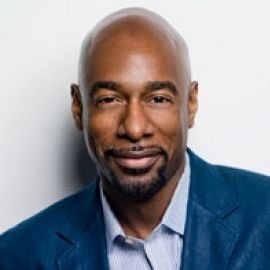
Michael’s career began in 1988 when he published Krush Magazine – the first publication ever devoted to covering the burgeoning world of hip-hop music exclusively.
Month’s later, other hip-hop publications would follow his lead, including The Source magazine.
Shortly thereafter, Michael set his sights on television. With just $300, Michael launched “Krush Rap” – a locally aired music video program that was eventually syndicated in 21 markets.
The weekly television series aired for two years, and generated over $500,000 in advertising dollars.
Next, Michael turned his attention to the book-publishing world. He authored, designed and self-published the hip-hop guidebook, The Unsigned Rappers’ Guide to Getting a Record Deal.
Within one year, the book yielded twelve times his investment.
Impressed with his track record in 1992, Michael caught the interest of the owners of The Source Magazine.
Recognizing his ability to “make things happen,” the owners offered Michael a position as Director of Special Projects.
While at The Source, Michael continued to explore unchartered waters. Radio was next. Michael was offered his own 2-hour weekly hip-hop show on one of Philadelphia’s top-rated radio stations, and thus began a weekly commute from New York back to his hometown, where he moonlighted as an on-air radio personality.
However, the commute would be a short one.
Impressed with Michael’s radio performance, New York’s famed hip-hop station, Hot 97, wanted in. Michael quickly made the transition from the country’s number four market to the country’s number one. And his voice was now being heard by millions of New Yorkers.
As such, Michael was simultaneously succeeding and ascending at the goals of his day job — taking The Source magazine to new heights, and at DJing. But before long, not even Hot 97 could contain him…
Sony Worldwide Networks had just partnered with hip-hop impresario Russell Simmons to launch a 2-hour nationally syndicated hip-hop countdown show. Michael was chosen to host and co-produce the weekly radio show, “Street Heat”.
For the next two years, Michael would work for The Source and Sony Worldwide Networks, hosting and co-producing what would become the most successful radio show of its kind, expanding its listeners into 42 markets, including Guam and St. Martin.
In 1995, Michael resigned from The Source and returned to Philadelphia. There, he would make plans to make his wildest dreams come true. Michael wanted to make movies, and where else would he do that? Hollywood.
Michael became aware of Sean “Diddy” Combs’ interest to establish a film and television arm of his highly successful hip-hop label, Bad Boy Records.
After meeting with Diddy about the future mogul’s plans, Michael relocated to Southern California in the fall of 1996, and was appointed President of Bad Boy Films.
Unfortunately, Michael’s tenure with Bad Boy Films would be short-lived. Four months into the job, Diddy’s friend and biggest star, The Notorious B.I.G., was murdered.
Forty-eight hours later, Bad Boy Films was dissolved, and Michael was unemployed. But failure was not an option. Neither was returning to the East Coast without succeeding in this new arena.
Armed with a computer, a book on screenwriting, and a Blockbuster Card, Michael began teaching himself to write screenplays. Approximately 13 months later – without the help of an agent or manager – Michael sold his first screenplay Seven Days to 20th Century Fox.
Upon reading of his successes in Hollywood, Michael’s former employer, The Source magazine contacted him with a handsome offer to return.
The hip-hop publication had been working unsuccessfully with the William Morris Agency to get their awards show to appear on network television.
After every network in Hollywood (including UPN), had passed on a proposal to do a special with The Source, Source owners turned to the one person they knew had the ability to “make things happen.”
Michael accepted the challenge, and as President of Source Entertainment struck an unprecedented deal for a special on UPN, within a month of taking his position.
As also the show’s Executive Producer, Michael’s “Source Hip-Hop Music Awards” (1999 and 2000) set new rating records for the struggling network and generated more than $15 million in revenue.
However, after violence broke out during the ‘2000’ airing of the show, Michael resigned to focus on his screenwriting and producing career. That decision proved to be a good one.
In less than one year of returning to the film business, Michael had 3 consecutive films ‘green lit’. These included the critically-acclaimed MTV’s Hip-Hopera: Carmen, which Michael scripted and executive produced, launching feature film careers for Mos Def, Bow Wow, Joy Bryant and of course, Beyonce Knowles.
In addition, Michael wrote the film Brown Sugar, a hip-hop love story that was made for $8 million. The film earned $11 million during its’ first weekend of release.
On less than 1,000 screens, Brown Sugar grossed nearly four times its’ cost to produce at the domestic box office.
Michael also wrote the family film Like Mike, which starred Bow Wow. Like Mike earned over $62 million at the box office. The film’s success on the home market prompted the making of Like Mike 2, four years after the original’s theatrical run, in July 2006.
In 2009, Michael’s screenplay Just Wright was filmed in New York, marking Michael’s fifth produced credit in 12 years. The romantic comedy stars Queen Latifah, Paula Patton and Common, and was released in theaters May 14, 2010 by Fox Searchlight Pictures.
Made for just $12 million, Just Wright earned the total amount spent to produce it within 8 days of its initial release.
And it did so from just 1,800 theaters – a mere 40% of the average theater count of a typical ‘wide’ release film.
In 2011, Just Wright was nominated for four NAACP Image Awards, including Outstanding Writing in a Motion Picture, which was presented to Michael on the stage of The Shrine Auditorium.
Over his 14-year screenwriting career, Michael has developed projects for some of Hollywood’s most important movie studios and television networks including Warner Bros. Pictures, 20th Century Fox, HBO, Walt Disney Pictures, Fox 2000 Pictures, BET, Universal Pictures, Fox Searchlight Pictures, VH1, Paramount Pictures, Showtime, and New Line Cinema.
As CEO of Michael Elliot Media, Michael continues to create motion pictures, mentor, and inspire others as a motivational speaker.