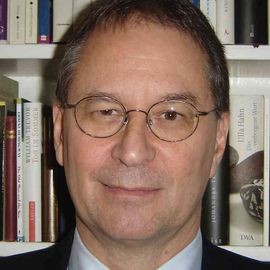
and the Center for Energy and Environmental Studies at Princeton University. Albright co-wrote four volumes, including the seminal World Inventory of Plutonium and Highly Enriched Uranium, 1992 (SIPRI and Oxford University Press), with Frans Berkhout of Sussex University and William Walker of the University of St. Andrews.
In March 1997, a revised and enlarged edition titled Plutonium and Highly Enriched Uranium 1996: World Inventories, Capabilities, and Policies was released.
Albright is also a co-editor and contributor to Challenges of Fissile Material Control (ISIS Press, 1999) and Solving the North Korean Nuclear Puzzle (ISIS Press, 2000), which one top expert on North Korea referred to as "the authoritative declassified study of the North Korean nuclear program." His book Peddling Peril: How the Secret Nuclear Trade Arms America's Enemies was released by Free Press in 2010.
The Atlantic named it one of the finest foreign policy books of 2010. Albright has spoken before the United States Congress on nuclear concerns several times during his career. He has addressed several organizations, technical seminars, and conferences, briefed government decision-makers, and educated a large number of government employees in non-proliferation policy formulation.
Albright is regularly quoted in the media, and he has made several appearances on television and radio. In a 2004 National Journal feature, he was described as the "go-to person for media folks seeking independent insight on Iraq's WMD programs." Albright has frequently been quoted in the media and has been on television and radio.
He has been quoted in the New York Times, Washington Post, USA Today, Los Angeles Times, Newsweek, Time, Washington Times, Boston Globe, Chicago Tribune, London Sunday Times, Guardian, Die Zeit, Ashi Shimbun, Der Spiegel, Stern, and Times of India, as well as by the wire services Reuters, Associated Press, AFP, and Bloomberg.
Albright has also been on CNN, FOX, MSNBC, ABC World News Tonight, NBC Nightly News, CBS Evening News, Newshour with Jim Lehrer, 60 Minutes, Dateline, Nightline, and a variety of National Public Radio programs. From 1992 through 1997, Albright actively collaborated with the IAEA Action Team, concentrating on assessments of Iraqi papers and prior procurement operations.
He was the first non-governmental investigator of Iraq's nuclear program in June 1996. Albright questioned members of Iraq's past nuclear enrichment programs during this inspection expedition about their assertions in Iraq's draft Full, Final, and Complete Declaration.
After the fall of Baghdad in the spring of 2003, he led a successful operation to recover the sole full collection of secret Iraqi materials concerning constructing gas centrifuges to enrich uranium for nuclear weapons, which had been concealed since the 1991 Gulf War. Albright served on Colorado Governor Roy Romer's Health Advisory Panel from 1990 until 2001.
The Panel, which reports to the state's Health Department, is in charge of conducting a historical evaluation of the toxicological and radiological doses received by the people surrounding the Rocky Flats nuclear weapons manufacturing facility.
Albright directed the creation of'source' words on this panel, which define the kind and amount of harmful compounds that left the facility through daily releases, accidents, or large-scale burns. Albright was named to the Department of Energy Openness Advisory Panel in 1996, which reports to the Secretary of Energy Advisory Board.
The group is tasked with examining the Department's Openness policy, which was established in 1993 with the goal of removing the veil of Cold War secrecy that has shrouded many of the DOE's activities while without endangering national security.
Prior to launching ISIS, he was a Senior Team Scientist at the Federation of American Scientists and a member of Princeton University's Center for Energy and Environmental Studies' research staff. He taught physics at George Mason University in Virginia in the early 1980s.
He has worked with the Environmental Policy Institute, the Congressional Research Service, the International Task Force on Nuclear Terrorism, Los Alamos National Laboratory, and the International Atomic Energy Agency as a consultant or contractor. He is a Fellow of the American Physical Society (APS). He received the Joseph A. Burton Forum Award from the APS in 2006.
He earned an Olive Branch Award in 1992 for a series of articles he co-wrote for the Bulletin of Atomic Scientists on Iraq's nuclear weapons development with Mark Hibbs. He was also a contributing editor for the Bulletin and a guest editor for special issues of the magazine.