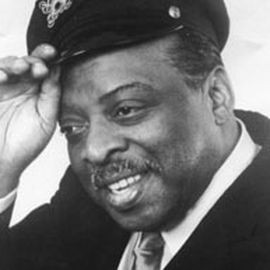
Basie was high and dry in Kansas City, Missouri, in 1927, while touring with Gonzelle White and the Big Jazz Jamboree. It seemed doubtful that Basie had followed Horace Greeley's or John B.L. Soule's invitation to go West as a young man, and his future was surely not certain.
According to Count Basie's autobiography, Good Morning Blues, "I don't recall what my intentions were at the time, but in the interim, I became sick and had to go to the hospital." Nonetheless, Kansas City was not a horrible location to be stuck for a musician of Basie's caliber.
Across the 1920s and 1930s, Kansas City was the headquarters for territory bands that performed in the Midwest and Southwest. KC was also a real melting pot for the heady mix of blues ideas, ineffably swinging rhythms, and great instrumentalists that crystallized into one of American music's hallmark sounds, both popular in its appeal and significant in its artistic meaning.
Basie rapidly became associated with the greatest of the territory bands, such as Walter Page's Blue Devils and Benny Moten's Kansas City Orchestra. By 1935, Count Basie's fate was becoming clear. He had created and was conducting the Count Basie Orchestra, which exemplified Kansas City Swing.
Basie's orchestra, together with the bands of Fletcher Henderson, Duke Ellington, and Benny Goodman, would define the big band period. While the media at the day proclaimed Benny Goodman to be the King of Swing, The Count was unquestionably the King of Swing. Basie's accomplishments, on the other hand, would transcend the Swing Era as a whole.
The Count Basie Orchestra grew into one of the most venerable and sustainable businesses in American music, as significant in its legacy and ongoing output as any musical organization of the twentieth, and now, twenty-first centuries. Surprisingly, the critical consensus characterizes the Basie lineage as the Old and New Testament ensembles.
The Old Testament band's style has been described as a blend of democratically developed, or head, riff-driven arrangements dripping with blues essence and relaxed, but relentless, swing that featured a who's who of very distinctive instrumentalists and vocalists, including Lester Young, Hershel Evans, Harry Edison, Buck Clayton, Dicky Wells, Jo Jones, Freddie Green, and Jimmy Rushing.
The New Testament Count Basie Orchestra sprang Phoenix-like from the ashes of the Big Band period in the early 1950s. The Count Basie Orchestra has been an arranger's palette for the last fifty years.
To mention a few of the more notable Basie penmen, Thad Jones, Ernie Wilkins, Neal Hefti, Sammy Nestico, and Frank Foster have contributed books to the Basie Library. The Basie repertoire has continued to grow harmonically and rhythmically as a result of them, making it more than welcoming to the skills of succeeding generations of players.
Basie's sensibility remained the ultimate even as he allowed for some modification and a diversity of perspectives to flourish on the platform he built. Since Basie's death in 1984, Thad Jones, Frank Foster, Grover Mitchell, Bill Hughes, and currently Dennis Mackrel have led the Count Basie Orchestra and kept it as one of the top performing groups in jazz.
Current members include musicians hired by Basie himself, such as John Williams (joined in 1970), Dennis Mackrel (joined in 1983), Carmen Bradford (joined in 1983), and Clarence Banks (joined in 1984), as well as Mike Williams (1987, formerly w/Glenn Miller, NTSU 1 O'Clock), Doug Miller (1989, formerly w/Lionel Hampton), Scotty Barnhart (1992), and members who have joined within the last 15